Discipline Without Distress by Judy Arnall
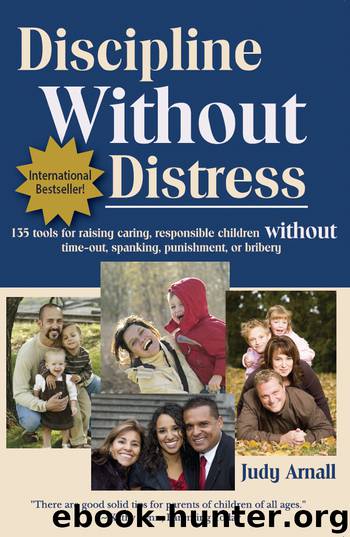
Author:Judy Arnall
Language: eng
Format: epub
ISBN: 9780978050900
Publisher: Professional Parenting
In times of stress, we parent how we were parented.
We can consciously change the pattern.
~ Patricia Morgan, Author
Most parents believe that REAL discipline starts at the toddler stage, when they are up and getting into things. Parents believe if they don’t nip many behaviors in the bud at this stage, the behaviors will grow and become monstrous later on and their children will be destined to become criminals because they were too lenient when they were toddlers. NOT TRUE!
The toddler stage is not a stage for real reasoning yet. They are just beginning to learn they can’t have their way all the time. Hence, the temper tantrums. The toddler’s physical development allows for lots of freedom and access to danger, yet his brain development has no self-control, internal restraints, logical reasoning, or negotiation. This is critical. The most parents can do at this stage is keep the toddler safe by childproofing, supervision, and teach by redirection and substitution. The good news is the toddler is still small enough to pick up and move around, away from danger and non-parent approved situations. Real teaching and discipline can come later in the preschool years, when brain development is much more advanced.
YOUR TODDLER’S DEVELOPMENTAL STAGE
Your toddler is in the “doing” developmental stage. She is quite mobile and curious and that will propel her to explore everything! This is very normal and necessary for her developing brain. She is experientially learning through her senses what her brain will be processing abstractly years later.
Typical toddler behaviors
Explores, explores, and more exploring with all her senses! Mouth, ears, eyes, touch, feel, nose. She is curious!
Tests reality by pushing boundaries. Starting to learn to think and follow simple instructions the odd time. Follows simple two-word commands and sometimes resists.
Feels all feelings. She can learn she has strong feelings but doesn’t know what to do with them yet.
Expresses negativity. Learns to say “no” and learns the power of the “no” word.
Alternates between clingy behavior and independent behavior. She wants to explore on her own but be able to retrieve her caregiver at will.
Uses body language to express negative feelings: hitting, biting, pushing, etc.
Wants to do everything themselves. “I do it!”
Dawdles because is so easily distracted.
ONE-YEAR-OLD DEVELOPMENTAL MILESTONES
Physical milestones
Clumsy with a spoon. Eats with hands. Explores textures. Can hold cup but drops.
Most front and side teeth in.
Drops morning nap. Sleeps around two hours in afternoon and 11 hours at night.
Can undress socks, hats, and shoes.
Stands without help, walks, can run and climb but may fall.
May crawl or walk up stairs with help.
Builds with two or three blocks or objects.
Pincer grasp develops.
Weight gain begins to slow down. Quantity of food intake drastically reduced.
Psychosocial milestones
Continues to form a bond and trust with caring adults.
Most play is solitary and parallel with other children, but may want caregiver close by.
Feels surprise, distress, disgust, pleasure, anger, sadness, fear, and joy.
Enjoys rhythm and likes to dance to music.
Repeats an activity, based on other’s reaction or to attract attention.
Kisses or hugs a familiar person.
Shows fears: animals, thunder, vacuums, theatres.
Download
This site does not store any files on its server. We only index and link to content provided by other sites. Please contact the content providers to delete copyright contents if any and email us, we'll remove relevant links or contents immediately.
The Lost Art of Listening by Michael P. Nichols(7506)
Rich Dad Poor Dad by Robert T. Kiyosaki(6633)
We Need to Talk by Celeste Headlee(5615)
I Love You But I Don't Trust You by Mira Kirshenbaum(3876)
The Complete Idiot's Guide to Coping With Difficult People by Arlene Uhl(3149)
Rich Dad Poor Dad: What The Rich Teach Their Kids About Money - That The Poor And Middle Class Do Not! by Robert T. Kiyosaki(2958)
A Burst of Light by Audre Lorde(2607)
The Book You Wish Your Parents Had Read (and Your Children Will Be Glad That You Did) by Philippa Perry(2528)
Dealing with People You Can't Stand by Dr. Rick Brinkman(2460)
Life Hacks by Dan Marshall(2456)
An Odyssey by Daniel Mendelsohn(2309)
The Expectant Father by Armin A. Brott & Jennifer Ash(2273)
Teach Your Child How to Think by Edward De Bono(2159)
No Time to Say Goodbye(2118)
What I Need by J. Daniels(2082)
The 7 Habits Of Highly Effective Teens by Covey Sean(2080)
The Out-of-Sync Child by Carol Stock Kranowitz(2055)
The Anxious Generation by Jonathan Haidt(2051)
I Don't Belong to You by Keke Palmer(2005)
